By Joseph M. Casciani, PhD
Here is a number that gets your attention: 45%.
The 2024 Lancet Commission identified 14 potentially modifiable risk factors and estimated that, collectively, they are associated with about 45% of dementia cases worldwide. The World Health Organization has used similar language in its dementia risk-reduction guidance.
That sounds like very good news. And it is.
But it is also easy to misunderstand.
It does not mean that you or I can reduce our personal risk of dementia by 45%. And it certainly does not mean that 45% of Alzheimer’s disease can be prevented if we simply exercise, eat properly, stay socially active, and keep our blood pressure under control.
The science is more complicated than that—and, I would argue, more interesting.
Prevention or Risk Reduction?
I prefer to talk about reducing the risk of dementia rather than preventing it.
Why the distinction?
Alzheimer’s disease has an underlying biological process involving beta-amyloid plaques and abnormal tau. Lewy body disease is associated primarily with alpha-synuclein, while major forms of frontotemporal dementia involve tau or TDP-43 pathology. And particularly as we grow older, these pathologies don’t always occur neatly by themselves. Mixed disease is common.
There is currently no good evidence that following a healthy lifestyle guarantees that these underlying disease processes won’t develop.
But that doesn’t mean we’re powerless.
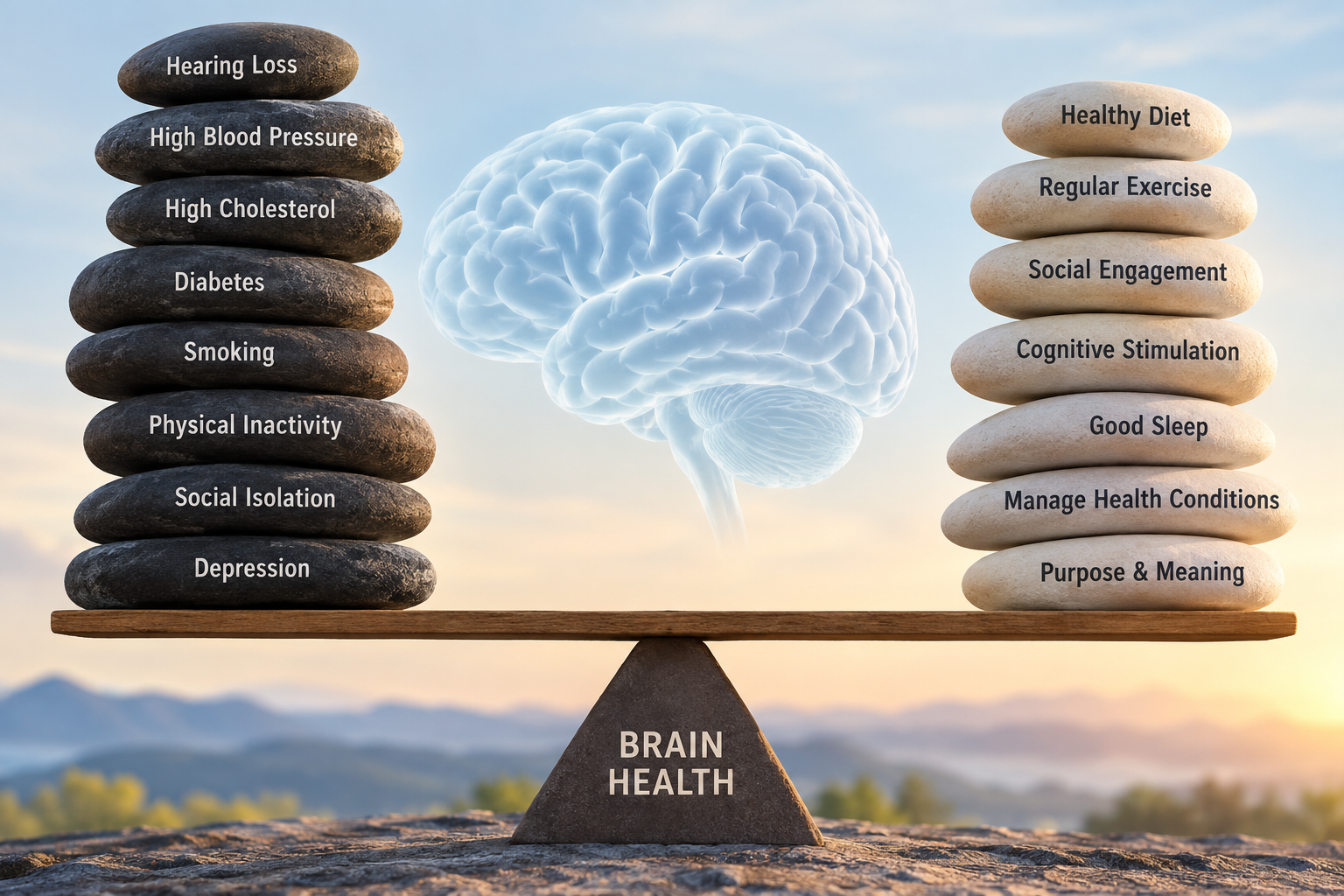
A more useful way of thinking about dementia is to consider the total burden on the brain.
Imagine that someone has some degree of Alzheimer’s pathology developing in the brain. Now add hypertension, diabetes, high cholesterol, smoking or obesity. These conditions can damage blood vessels in the brain and contribute to small-vessel disease, infarcts and white-matter injury. That additional vascular burden can coexist with Alzheimer’s pathology and may lower the threshold at which cognitive problems become clinically apparent.
Other factors may affect the brain through different pathways. Hearing loss, social isolation, depression and physical inactivity may influence cognitive reserve, sensory stimulation, mood, vascular health and other processes. The mechanisms aren’t identical, and in some cases we’re still learning exactly how the relationships work.
So perhaps the better question isn’t:
“Can I prevent dementia?”
It is:
“What can I do to reduce the burden on my brain and influence the course of my cognitive health?”
That is a question we can do something about.
The 14 Factors We Can Potentially Influence
The Lancet Commission looks at dementia risk across the entire life course—not simply at what people should start doing when they reach their 70s.
Its 14 potentially modifiable risk factors are:
- Less education
- Hearing loss
- High LDL cholesterol
- Hypertension
- Obesity
- Traumatic brain injury
- Excessive alcohol consumption
- Smoking
- Depression
- Physical inactivity
- Diabetes
- Social isolation
- Air pollution
- Untreated vision loss
High LDL cholesterol and untreated vision loss were added to the list in 2024. And although the Lancet associates different factors with different stages of life, that does not mean they suddenly stop mattering when we pass a particular birthday.
There is another important qualification: the evidence is not equally strong for every factor. Much of the dementia-risk literature is observational. An association between a particular factor and dementia does not by itself prove that eliminating that factor will prevent dementia.
Again, risk reduction is not a guarantee.
But Can Changing Our Lifestyle Really Make a Difference?
Increasingly, the evidence says it can—particularly when we look at cognitive functioning rather than make the much stronger claim that lifestyle prevents Alzheimer’s disease itself.
One fascinating example comes from Dr. Dean Ornish and colleagues. In a small randomized Phase 2 trial involving people with mild cognitive impairment or early dementia due to Alzheimer’s disease, participants followed an intensive program involving a whole-food plant-based diet, exercise, stress management and group support.
After 20 weeks, the intervention group performed significantly better than controls on several measures of cognition and function. Researchers also found a favorable change in one Alzheimer’s-related blood biomarker, the plasma Aβ42/40 ratio.
Those findings are intriguing. But they do not demonstrate that lifestyle modification prevents the development of amyloid plaques or neurofibrillary tangles. Longer follow-up continued to show encouraging cognitive and functional findings, but there was no significant between-group change in p-tau217, an important marker of Alzheimer’s tau pathology. The trial was also small, relatively short and has been subject to methodological criticism.
A much larger study, the U.S. POINTER trial, involved more than 2,000 older adults at increased risk for cognitive decline. Participants received multidomain lifestyle interventions involving exercise, nutrition, cognitive and social activity, and cardiovascular-health monitoring. Both groups improved cognitively, with greater benefit from the more structured intervention.
That provides stronger evidence that lifestyle intervention can help preserve cognition in people at increased risk. But once again, the study demonstrated effects on cognition, not prevention of Alzheimer’s neuropathology.
That’s an important distinction.
What Should We Actually Do?
The World Health Organization’s recommendations are refreshingly practical. Stay physically active. Don’t smoke. Avoid harmful alcohol use. Eat a healthy diet and maintain a healthy weight. Manage hypertension, diabetes and high cholesterol. Address hearing loss. Remain cognitively and socially engaged.
And don’t assume that the answer comes in a bottle. WHO does not recommend vitamin B or E, omega-3, or multivitamin/mineral supplements specifically to prevent cognitive decline or dementia in people without a diagnosed deficiency because the evidence has not established sufficient benefit.
None of this is particularly exotic. There is no magic brain-health formula hiding here.
It is largely about taking care of the brain by taking care of the person.
Influence, Not Control
As a psychologist who has spent much of my career working with older adults, this is where the research becomes especially meaningful to me.
Aging has never been about controlling every outcome. We can’t.
We cannot choose our genes. We cannot eliminate every disease process. We cannot guarantee that if we exercise, eat properly, stay engaged, manage our blood pressure and do everything else “right,” dementia won’t enter our lives.
But lack of control does not mean lack of influence.
We can influence our cardiovascular health. We can stay physically active. We can treat hearing and vision problems. We can remain connected with other people. We can continue learning. We can manage the health conditions that add unnecessary burden to the brain.
And perhaps that is a more realistic—and ultimately more useful—way to think about dementia risk.
The goal isn’t to earn a guarantee that we will never develop dementia.
The goal is to give our brains the best opportunity we can, for as long as we can.
So, can we prevent dementia?
For now, I think that’s the wrong question.
A better one is: What can I influence today that may change the course of tomorrow?
About the Author
Joseph M. Casciani, PhD, is a psychologist, geropsychologist, author, and founder of the Living to 100 Club. For more than four decades, his work has focused on older adults and the psychology of aging. Through his writing, speaking, and educational programs, he encourages a realistic approach to aging—one centered on resilience, purpose, adaptation, and the choices that remain within our influence.
Author’s note: This article was developed with research and editorial assistance from ChatGPT by OpenAI.
Leave a Reply