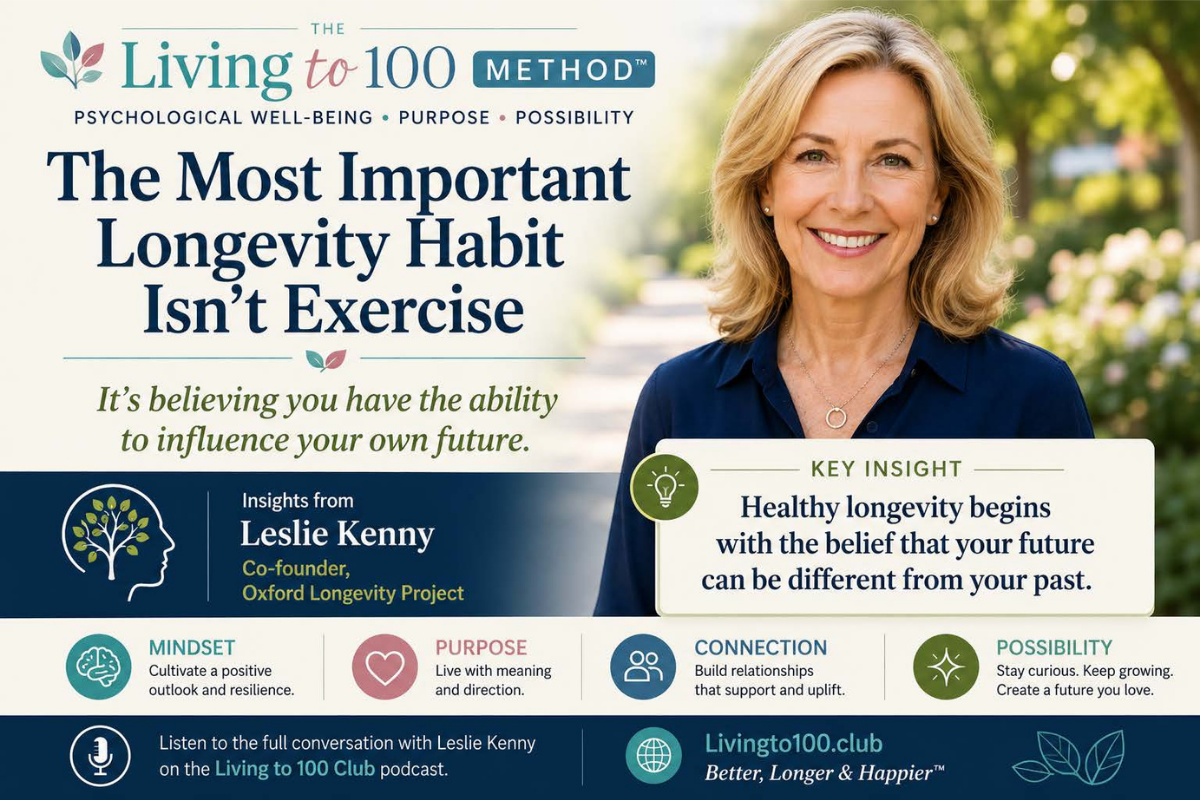
It’s believing you have the ability to influence your own future.
By Joe Casciani, PhD
If someone asked you what contributes most to a longer, healthier life, what would you say?
Exercise?
Nutrition?
Sleep?
Stress management?
All are important. But after a recent conversation with Leslie Kenny of the Oxford Longevity Project, I came away thinking that one factor may come even before those: our belief that our choices still matter.
The Oxford Longevity Project recently surveyed more than 14,500 people across 25 countries to better understand attitudes toward longevity and healthy aging. The findings were encouraging—and concerning.
About half of respondents believed they had some control over how they age. But many also admitted they didn’t know what actions to take, and many felt they lacked the resources to improve their future.
That struck me because I hear a similar uncertainty in my own work with older adults.
From Maintenance to Possibility
During discussion groups in senior living communities, I often hear conversations centered on maintenance.
Maintaining health.
Preserving independence.
Maintaining routines.
Those are worthwhile goals.
But I often encourage people to ask a different question:
What am I still moving toward?
That subtle shift changes the conversation from preserving what’s left to creating what comes next.
Healthy aging isn’t simply about avoiding decline. It’s about remaining engaged in life and believing that tomorrow can still hold purpose, growth, relationships, and new experiences.
Agency: The Psychology Behind Healthy Aging
Psychologists sometimes use the word agency to describe our belief that we can influence what happens in our lives.
Agency doesn’t mean we control everything.
It means we recognize that our daily choices—large and small—still matter.
That’s an important distinction.
None of us chooses our genes. None of us can prevent every illness or setback. But we do choose how we respond. We choose whether we remain curious, connected, active, and hopeful.
Those choices accumulate over time.
Leslie’s Story
Leslie shared something deeply personal during our conversation.
At age 39, she was diagnosed with rheumatoid arthritis and lupus. She recalls being told to expect her condition to worsen and that her future would be severely limited.
Many people would have accepted that prognosis as the final word.
Instead, Leslie asked herself a different question.
“Is there another possibility?”
She became an active participant in her own health. She explored nutrition, lifestyle changes, stress reduction, and other approaches alongside medical care. Within months, her symptoms improved dramatically, and she eventually entered remission.
Her story isn’t a promise that every illness can be reversed.
It is a reminder that we often have more influence than we initially believe.
Small Steps Matter
One message from the Oxford Longevity Project is refreshingly practical.
Healthy aging rarely depends on one dramatic change.
It grows from consistent, manageable habits.
Drink more water.
Take a walk.
Volunteer.
Learn a new skill.
Reconnect with a friend.
Sleep a little better.
Choose one healthier meal today.
None of these actions is remarkable by itself.
Together, they create momentum.
More importantly, they reinforce a powerful belief:
“I can still shape my future.”
A New Prime of Life
Leslie offered another perspective that resonated with me.
She described later life not as a period of decline, but as a new prime—a season with greater freedom to pursue interests, deepen relationships, contribute to others, and focus on what truly matters.
I like that image.
For many people, retirement removes deadlines, career pressures, and family obligations that dominated earlier decades. Rather than asking, “What’s ending?” perhaps we should ask,
“What is now possible?”
That question opens doors.
Your Next Chapter
Healthy aging isn’t reserved for people with perfect genes or unlimited resources.
It begins with a decision.
The decision to believe that your actions still matter.
You don’t need to transform your life this week.
Just begin.
Read something that stretches your thinking.
Call someone you’ve been meaning to reconnect with.
Take a walk.
Volunteer.
Learn.
Create.
Plan something worth anticipating.
The goal isn’t simply to add years to life.
It’s to add life to your years.
And perhaps the most important step of all is believing that your next chapter is still being written.
Listen to the Full Conversation
To hear my full conversation with Leslie Kenny of the Oxford Longevity Project, listen to the latest episode of the Living to 100 Club podcast. Together, we explore the science of longevity, the importance of mindset, and why it’s never too late to take meaningful steps toward a healthier, more fulfilling future.
Your Next Step
Living longer isn’t the goal. Living with purpose, curiosity, and hope is. Whatever your age, choose one small action this week that moves you toward the life you want to be living a year from now.
About the Author
Joseph Casciani, PhD is a clinical psychologist, geropsychologist, speaker, and host of the Living to 100 Club podcast. For more than 40 years, he has worked with older adults, families, and senior living organizations, helping people embrace healthier aging through purpose, resilience, and psychological well-being. Dr. Casciani is the creator of the Better, Longer & Happier™ educational series and the author of Living Longer IS the New Normal. Learn more at Livingto100.club.