


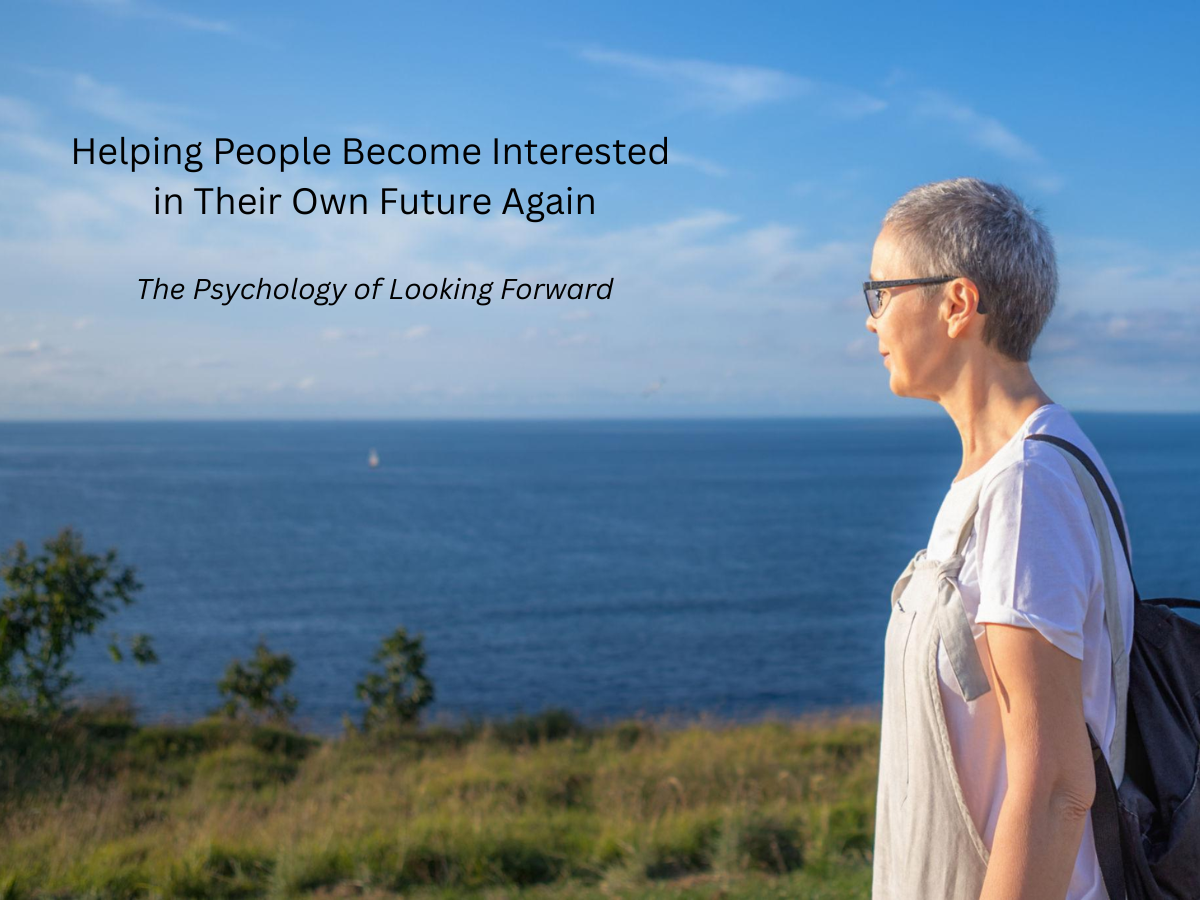
Healthy aging isn’t only about staying physically active. It also depends on whether we remain interested in what lies ahead. One of the most powerful aspects of a healthy aging mindset is continuing to see possibility in our future.
Recently, I had the opportunity to lead a discussion with a group of older adults. Instead of giving another presentation, I asked three simple questions.
What gave your life purpose in the past?
What brings you joy today?
What would you still like to learn, experience, or contribute in the future?
The responses surprised me.
The first question was easy. People spoke with pride and warmth about careers, raising families, volunteer work, military service, friendships, travel, and accomplishments. Their stories flowed naturally. They knew who they had been.
The second question took a little more thought.
When I asked what brings them joy today, the room became quieter. The answers came more slowly.
Then came the third question.
What would you still like to learn, experience, or contribute?
This was by far the most difficult question.
What struck me was that relatively few people talked about what they hoped to learn, create, or experience next. The conversation naturally drifted back to familiar memories and present-day concerns.
That’s when I realized I wasn’t simply asking about future plans. I was asking whether people still felt drawn toward the future itself.
Do you still have an active relationship with your future?
It struck me that many of us become excellent historians of our own lives. We can tell wonderful stories about where we’ve been, what we’ve accomplished, and the people we’ve loved.
But somewhere along the way, many of us stop asking an equally important question:
Who am I still becoming?
Perhaps one of the quietest losses that can accompany aging is not physical ability or even retirement.
Perhaps one of the quiet challenges of aging is that our attention slowly shifts from possibility to maintenance.
Not all at once.
Quietly.
We begin thinking more about maintenance than possibility. More about getting through the day than discovering what the day might hold.
Yet I have seen the opposite happen, too.
I’ve met people who decided to run their first marathon in later life. Others who learned to play a musical instrument, wrote a book, joined a volunteer organization, took up painting, or simply made a commitment to meet new people. None of these decisions changed the past.
They changed the future.
What they all shared wasn’t extraordinary talent or perfect health.
They had become interested in their future again.
That may be one of the most overlooked ingredients of healthy aging.
We often talk about exercise, nutrition, sleep, and medical care—and all are important. But psychological health also depends on having something that draws us forward, something that sparks curiosity, purpose, connection, or simply enjoyment.
We don’t need to know exactly what the next chapter will look like.
We only need to believe there is another chapter worth writing.
So let me leave you with a question.
What are you looking forward to?
It doesn’t have to be something grand.
Perhaps it’s learning a new skill.
Joining a group.
Reconnecting with an old friend.
Volunteering.
Traveling.
Playing music.
Or simply trying something you’ve always thought about but never made time for.
Healthy aging isn’t simply about avoiding disease or extending life.
It’s about remaining interested in the life that is still unfolding.
Because growth doesn’t begin with action.
It begins with interest.
About the Author
Dr. Joseph Casciani is a psychologist, speaker, and founder of the Living to 100 Club. For more than 40 years, he has helped older adults, families, and professionals discover practical ways to age with resilience, purpose, and connection. Through his writing, podcast, and educational programs, he encourages people to remain curious, continue growing, and become interested in the future that is still unfolding.
Learn more at Livingto100.Club.