
When Support Doesn’t Require Long Conversations
Years ago, while working as a psychologist with people in the 55+ age group, I began using an approach I came to call the “15-minute hour,” inspired by the book The Fifteen Minute Hour by Joseph A. Lieberman and Marian R. Stuart. The idea was simple but somewhat unconventional. I learned that meaningful conversations and support do not always require long counseling sessions. In many cases, meaningful conversations with older adults could unfold in just a few focused minutes. And, around that same time, Medicare and other insurers also began encouraging shorter behavioral health visits—recognizing that brief, focused conversations could still have meaningful impact.
Many clinicians then believed that effective therapy required extended conversations, deep exploration of the past, and multiple sessions to untangle complicated emotional dynamics. But what I was seeing in practice with seniors suggested something different. Often, people didn’t need lengthy analysis. What they needed was a brief but focused moment of understanding.
A thoughtful conversation, even a short one, could sometimes help someone regain perspective and feel less alone.
Over time I realized that the principles behind the “15-minute hour” weren’t limited to clinical settings. In fact, they apply to everyday life. Family members, caregivers, friends, and staff in senior communities often find themselves wanting to help someone who is feeling discouraged, overwhelmed, or uncertain. Yet many people hesitate because they’re unsure what to say.
The good news is that meaningful support does not require the perfect words. Often it simply requires presence and curiosity.
Why Advice Isn’t Always the Best Response
One of the misconceptions about helping others is that we need to provide advice. When someone shares a difficulty, our instinct is to offer solutions. Advice can certainly be useful in some situations, but when a person is struggling emotionally, advice can sometimes close the door too quickly. It may unintentionally suggest that we understand their situation better than they do.
A more helpful approach is often to ask thoughtful questions and allow the person to reflect.
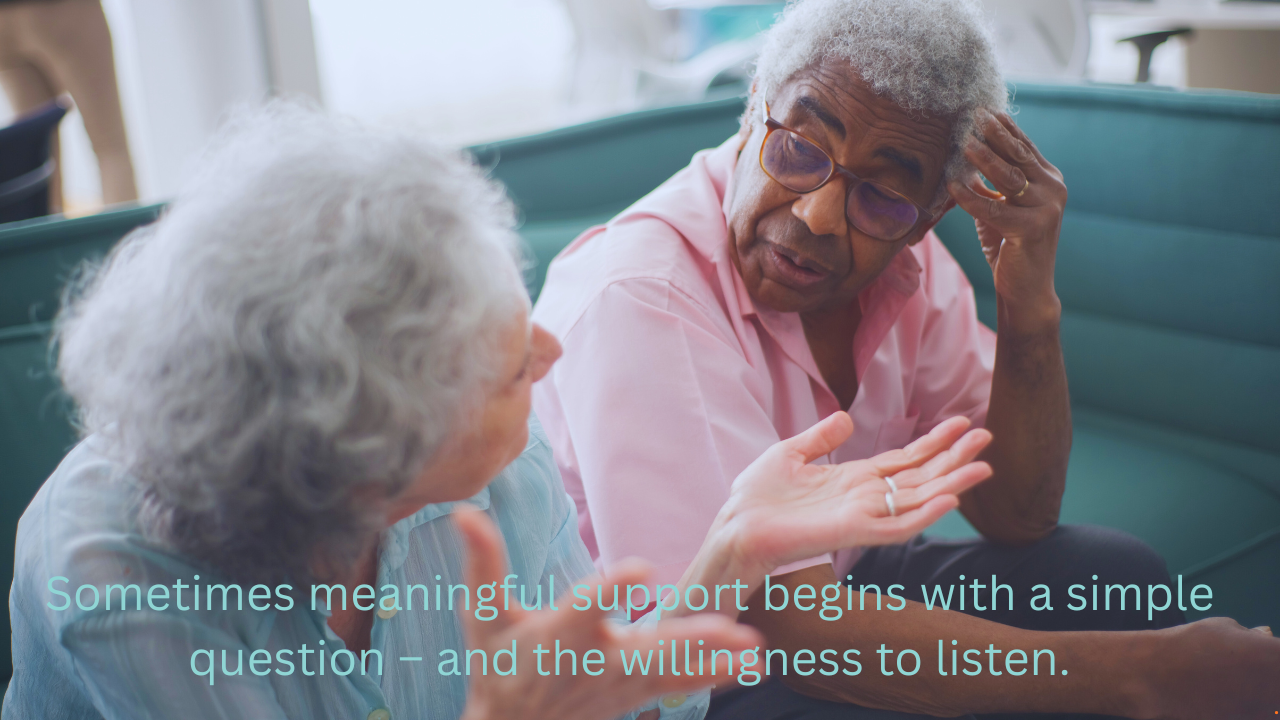
Sometimes the most powerful moment in a conversation is when someone realizes that someone finally asked.
Five Questions That Can Guide a Meaningful Conversation
In my work, I sometimes used a simple conversational framework to guide these short supportive conversations. It involved a handful of questions that help bring clarity and understanding without overwhelming the person.
The first question focuses on background. What has been happening recently? A brief snapshot of the situation helps establish context.
Next comes affect, or feeling. How did the situation make the person feel? Naming emotions often helps people make sense of their experience.
Then we explore trouble. What part of the situation feels most difficult or troubling right now? This question helps identify what truly matters to the person.
After that comes handling. How has the person been coping with the situation so far? This question often reveals strengths that the individual may not fully recognize.
Finally, there is empathy. This is where we acknowledge the person’s effort, perspective, or resilience. A simple statement of understanding can go a long way toward helping someone feel supported.
These steps don’t require a formal counseling setting. They can unfold naturally in a conversation with a friend, a family member, or someone in a senior community who simply needs to talk.
Why Meaningful Conversations Matter More as We Age
What makes these brief conversations powerful is not their length but their focus. When someone feels listened to—really listened to—it can shift their outlook. They may begin to see possibilities they hadn’t considered or regain confidence in their ability to cope.
In many cases, the goal of the conversation is not to “solve” the problem but to help the person reconnect with their own capacity for managing it. Short conversations can sometimes have the biggest impact on emotional well-being in later life.
Older adults in particular often face moments of adjustment and loss: changes in health, shifts in independence, or the absence of long-standing relationships. These experiences can lead to feelings of sadness, frustration, or uncertainty. Yet older adults also possess remarkable resilience and life experience. When given the opportunity to reflect on their situation, they frequently discover their own ways forward.
Sometimes all it takes is a short conversation that invites that reflection.
When Someone Finally Feels Heard
I have often been struck by how meaningful these moments can be. A person may begin the conversation unsure or discouraged, but after a few minutes of thoughtful exchange, their posture shifts, their tone changes, and they begin to speak with greater clarity.
It is not unusual for someone to respond with a quiet sense of relief, as if to say, “I’m glad someone asked.”
That moment is powerful. It reminds us that connection itself can be therapeutic.
A Simple Tool to Start Meaningful Conversations
In recent years I created a small resource called the Conversation Starter Workbook, designed to help make these kinds of conversations easier to begin. It offers prompts and questions that encourage reflection and meaningful dialogue.
But the real lesson of the “15-minute hour” is not about a workbook or a particular method. It is about remembering that a small moment of attention can have a large impact.
Sometimes the most helpful thing we can offer another person is simply the opportunity to speak—and the assurance that someone is willing to listen.
Small moments of understanding often lead to larger changes in how we experience aging and the people around us.
Closing
Moments like these also remind us that helping someone does not always mean offering advice. In fact, advice can sometimes unintentionally close the very door we are trying to open. A thoughtful question, a moment of listening, or a brief conversation that invites reflection can often be far more helpful. I wrote about this idea more fully in a recent article, “When Helpful Advice Quietly Undermines Aging Well,” which explores why curiosity and listening often support older adults better than quick solutions. Together, these approaches remind us that meaningful conversations—no matter how brief—can create space for insight, dignity, and resilience.
Joseph M. Casciani, PhD, is a geropsychologist and founder of the Living to 100 Club, where he shares insights on psychologically healthy aging through articles, podcasts, and community discussions. Over the course of his career, Dr. Casciani has worked with older adults, caregivers, and senior living communities to promote resilience, meaningful engagement, and emotional well-being in later life.
This article draws on ideas originally presented in a seminar on behavioral health with mental health professionals delivered in North Texas in 2005, where Dr. Casciani introduced the concept of the “15-Minute Hour”—the idea that even brief conversations can provide meaningful support during times of stress, adjustment, or loss.


Becky Blue
Hello Dr. Joe,
I’ve been following you since I guested on your show a few years back.
I was happy to run across this article today as I prepare for a talk to
senior companion volunteers. So helpful!
Thank you! Getting ready to publish a new book. Hope to visit with you
about it this fall!
Becky Blue, RN, MS